
1500 Calories and Hunger: How to Plan Meals Without Losing It by Day 3
A 1500-calorie diet is one of the most commonly searched calorie targets — low enough to create a real deficit for most people, but, if poorly structured, restrictive enough that by day three you're standing in the kitchen at 10 p.m. looking for anything to eat. The problem is almost never the number 1500 itself. It's how those calories are distributed.

Mistake number one: too little protein
Protein keeps you feeling full longer and more strongly than carbs or fat at the same calorie count. A 1500-calorie diet built mostly around carbs — bread, pasta, fruit — will trigger hunger much faster than the same number of calories built around a solid protein portion at every meal.
Mistake number two: too much time between meals
Three large meals a day on a deficit can mean several hours of hunger in between, which leads to snacking or overeating at the next meal. Spreading the same total calories across four smaller meals is often easier to sustain, though this varies a lot from person to person.
Mistake number three: cutting out fat entirely
Fat slows down stomach emptying, which extends the feeling of fullness. A nearly fat-free 1500-calorie diet built mainly on lean protein and carbs can, counterintuitively, feel less satisfying than one with a reasonable amount of healthy fats — olive oil, nuts, avocado.
Mistake number four: not enough volume per meal
A plate full of low-calorie vegetables (lettuce, cucumber, bell pepper, broccoli) creates physical fullness — your stomach fills up — at a relatively small calorie cost. A calorie-dense but small-volume meal doesn't deliver that same fullness, even at the same calorie count.
How to put this together in practice
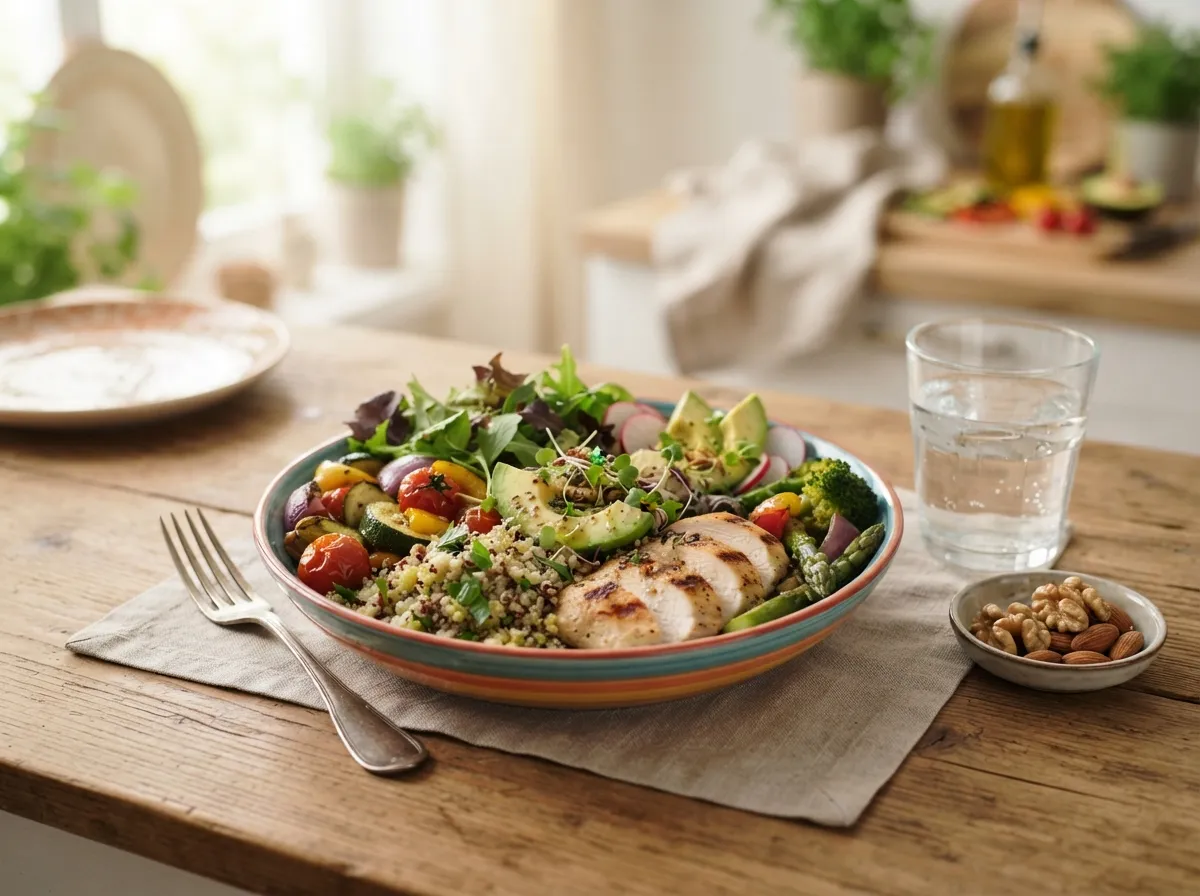
A well-balanced meal on a 1500-calorie diet usually looks like this: a solid portion of protein (meat, fish, eggs, legumes), a generous portion of vegetables for volume, a moderate portion of complex carbs, and a bit of healthy fat. Spread across 3-4 meals a day, that combination fits within 1500 calories and actually keeps you full — unlike the same calorie count made up mostly of snacks and bread.
Why doing this manually gets exhausting
The theory is simple, but recalculating calories and macros for every single meal, day after day, to hit exactly 1500 calories while keeping the right ratios, is a real mental load to carry. That's why a meal plan that handles that balance for you — like the generator in Swaplate — takes that part of the work off your plate, leaving you with just one decision: what you actually feel like eating.
Want to plan your meals with the help of AI?
Sign up for Swaplate →